Google BigQuery
Events can be sent to a Google BigQuery table using the bigQuery sink type.
Like all Sinks, BigQuery sinks can be created in the Stream Portal…
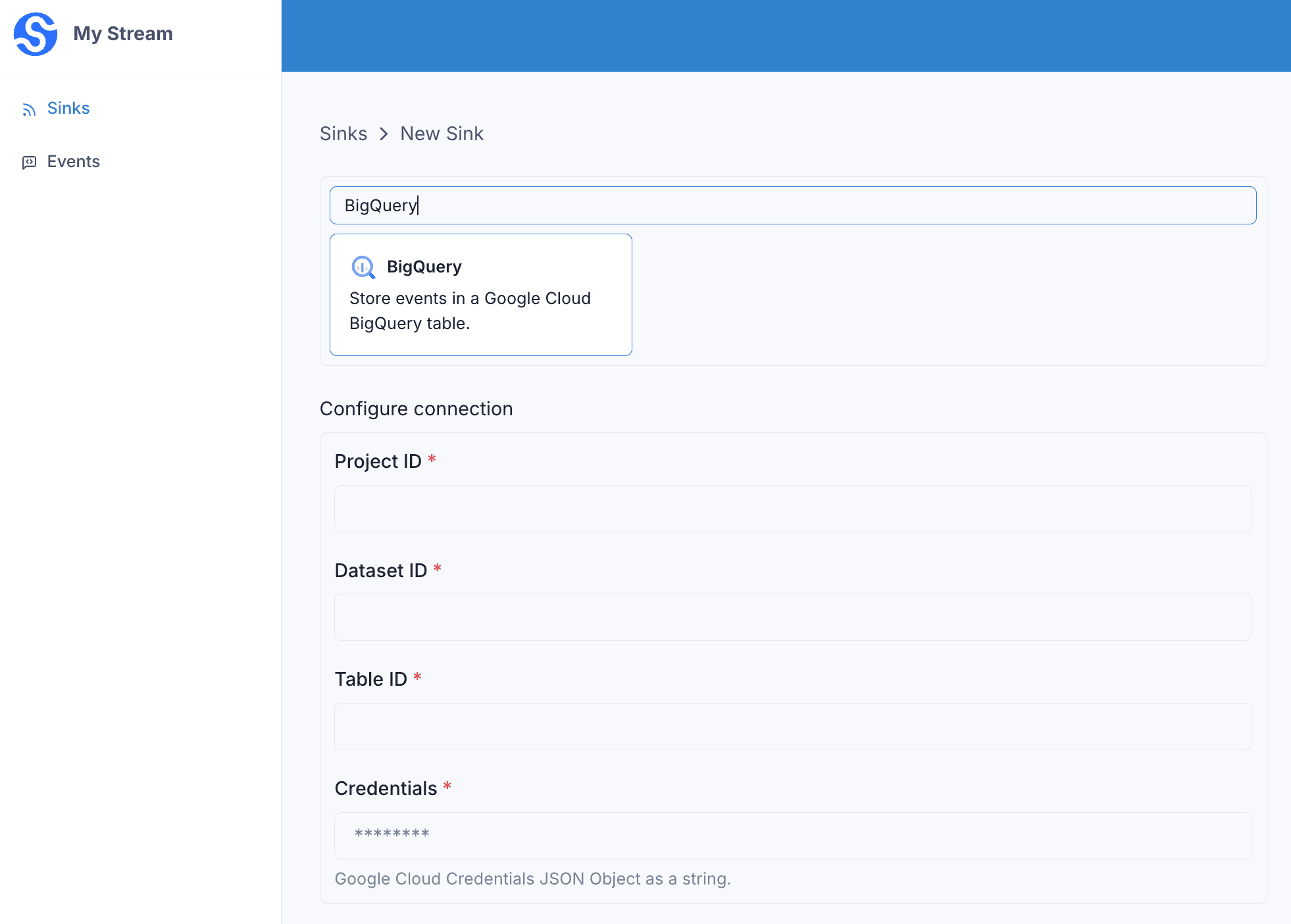
… or in the API .
curl -X 'POST' 'https://api.svix.com/api/v1/stream/strm_30XKA2tCdjHue2qLkTgc0/sink' \
  -H 'Authorization: Bearer AUTH_TOKEN' \
  -H 'Content-Type: application/json' \
  -d '{
  "type": "bigQuery",
  "config": {
    "projectId": "my-gcp-project",
    "datasetId": "my_dataset",
    "tableId": "events",
    "credentials": "<json encoded service account credentials>"
  },
  "uid": "unique-identifier",
  "status": "enabled",
  "batchSize": 1000,
  "maxWaitSecs": 300,
  "eventTypes": [],
  "metadata": {}
}'
Every event batch is inserted into the configured BigQuery table.
projectId— the GCP project that owns the dataset.datasetId— the BigQuery dataset that contains the table.tableId— the table that receives the rows.credentials— a Google Cloud service account credentials JSON object, provided as a string.
Destination table
Without a transformation, Svix inserts each event into the table identified by projectId, datasetId, and tableId using two columns: id and payload. Svix generates a unique id for each row and writes the raw event payload to payload.
The table must already exist before you enable the sink. For the default behavior, create it with:
CREATE TABLE `my-gcp-project.my_dataset.events` (
  id STRING,
  payload STRING
);
If you use a transformation (below), you control the columns each row contains, so your table can use any schema you like — as long as it matches the rows your transformation returns.
Transformations
Each event is inserted into BigQuery as a row. A transformation returns the rows to insert, where each row is an object whose keys match your table’s columns.
/**
 * @param input - The input object
 * @param input.events - The array of events in the batch. The number of events in the batch is capped by the Sink's batch size.
 * @param input.events[].payload - The message payload (string or JSON)
 * @param input.events[].eventType - The message event type (string)
 *
 * @returns Object describing the rows to insert.
 * @returns returns.rows - The array of rows to insert. Each row is an object whose keys match the columns of your BigQuery table.
 */
function handler(input) {
    const rows = input.events.map((event) => ({
        id: crypto.randomUUID(),
        payload: JSON.stringify(event.payload)
    }));

    return { rows };
}
input.events matches the events sent in create_events.
Each entry in the returned rows array is inserted as a separate row. The object keys must match the column names of your table. To write different columns, adjust the objects in rows and your table schema to match.
For example, if the following events are written to the stream:
curl -X 'POST' \
  'https://api.svix.com/api/v1/stream/{stream_id}/events' \
  -H 'Authorization: Bearer AUTH_TOKEN' \
  -H 'Accept: application/json' \
  -H 'Content-Type: application/json' \
  -d '{
        "events": [
            {
                "eventType": "user.created",
                "payload": "{\"email\": \"joe@enterprise.io\"}"
            },
            {
                "eventType": "user.login",
                "payload": "{\"id\": 12, \"timestamp\": \"2025-07-21T14:23:17.861Z\"}"
            }
        ]
    }'
The transformation above inserts two rows into your table.
id | payload |
|---|---|
1f0a8c1e-... | {"email":"joe@enterprise.io"} |
4b9d2e7a-... | {"id":12,"timestamp":"2025-07-21T14:23:17.861Z"} |