Amazon SQS
Svix can deliver webhooks directly to an Amazon SQS queue, without your customers having to set up any listener endpoint or write any glue code.
When Advanced Destinations is enabled, your customers will see the option to use an SQS destination in the App Portal.
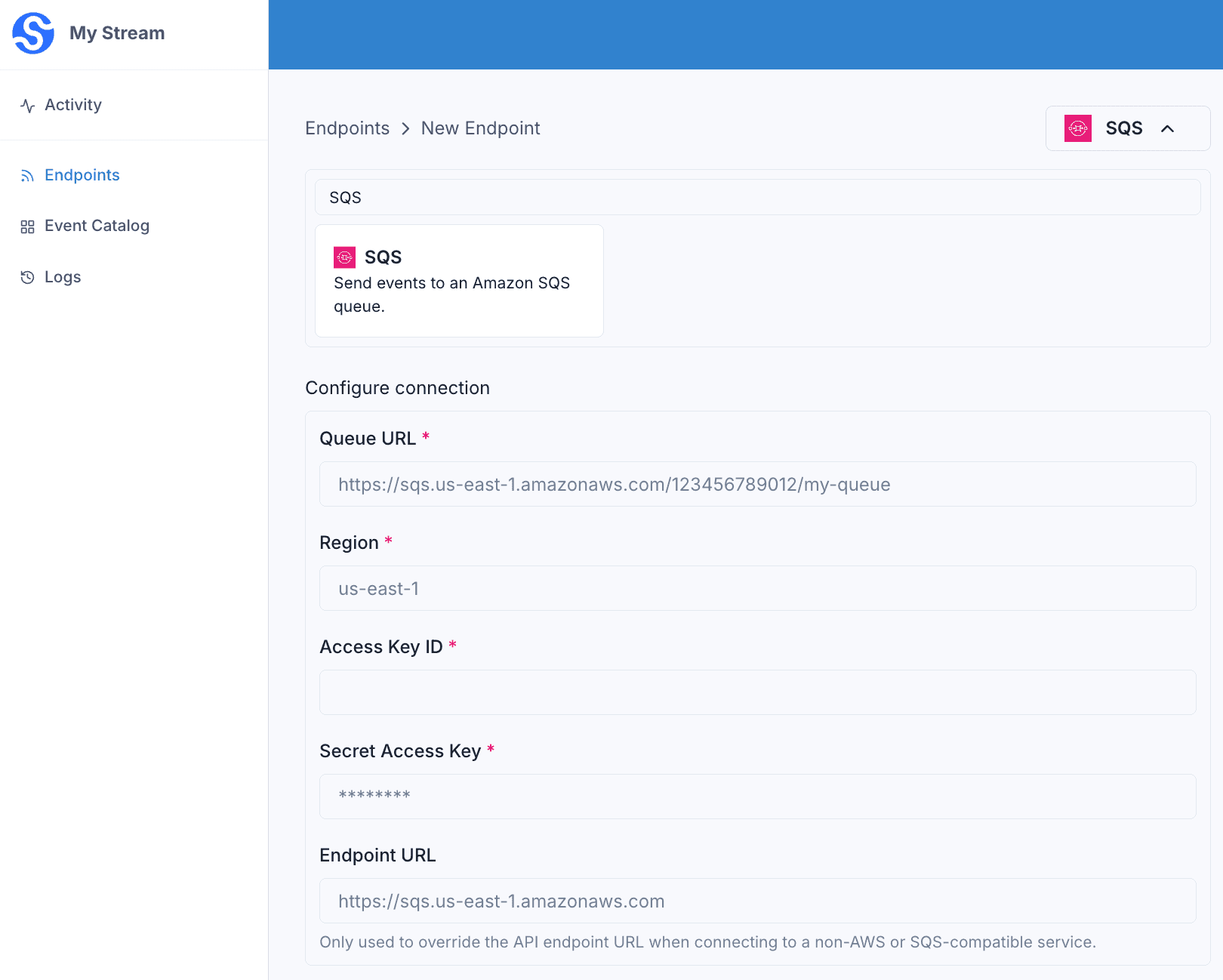
They will be able to configure the connection right in the App Portal:
queueUrl— the full URL of the SQS queue to send messages to.region,accessKeyId,secretAccessKey— the AWS region and credentials used to authenticate.
Every webhook in the batch is sent to the queue as a separate message.
Transformations
By default, all SQS Endpoints come bundled with the following transformation code.
/**
 * @param input - The input object
 * @param input.events - The array of webhooks in the batch. The number of webhooks in the batch is capped by the endpoint's batch size.
 * @param input.events[].payload - The message payload (string or JSON).
 * @param input.events[].eventType - The message event type (string).
 *
 * @returns Object containing the response.
 * @returns returns.messages - The array of SQS messages to send to the SQS queue.
 * @returns returns.messages[].payload - The payload of the message (string).
 */
function handler(input) {
  const messages = input.events.map((event) => ({
    payload: event,
  }));

  return {
    messages,
  };
}
input.events is the list of webhooks received by the endpoint, processed in batches.
Each entry in the returned messages array is sent as a separate SQS message, with its payload used as the message body. By default, each webhook is sent as its serialized JSON.
For example, if the endpoint receives the following messages:
{
  "eventType": "user.created",
  "payload": "{\"email\": \"joe@enterprise.io\"}"
}
{
"eventType": "user.login",
"payload": "{\"id\": 12, \"timestamp\": \"2025-07-21T14:23:17.861Z\"}"
}The default transformation code would send two messages to your queue, with the following bodies.
{"payload":{"email":"joe@enterprise.io"},"eventType":"user.created"}{"payload":{"id":12,"timestamp":"2025-07-21T14:23:17.861Z"},"eventType":"user.login"}To control the message bodies, return your own array of messages. Each message’s payload becomes the body of one SQS message.
SQS accepts at most 10 messages per batch request, so larger batches are automatically split across multiple SendMessageBatch calls.